



Winston Churchill once remarked that, “Men occasionally stumble over the truth, but most pick themselves up and hurry off as if nothing happened.”
Though he was referring to a political adversary, he just as easily could have been talking about our behavior change commitments. Whether considering our last New Year’s resolution, weight loss promise, or leadership improvement priority, chances are that we didn’t change our behavior as quickly, easily, or reliably as we’d intended, if indeed we changed at all. We saw the need to change for the better, we earnestly committed to make that change, and then, well…old habits can be hard to break and adopting new habits can be equally challenging.
Indeed, 80% of people give up on their New Year’s resolutions by February, and only a third of people who experience a cardiac event (like a heart attack or stroke) change their exercise habits afterward. When it comes to leadership teams, behavior change is no less challenging. Consider, according to McKinsey research, 1 in 3 failed transformations occur because the leadership team’s behaviors did not support the desired changes.
Suppose this didn’t have to be the case. What if there were reliable ways to change our behavior, individually or as a group? What if our behavior change could happen quickly and sustainably? And, what if such methods could be applied to enhance performance in the workplace? In our experience, there is no silver bullet when it comes to behavior change. But, there are specific, frequently-occurring performance conditions in the workplace that, when combined with proven methods, lend themselves to behavior change that is more reliable and meaningful than is commonplace today.
1 IN 3 FAILED TRANSFORMATIONS
occur because the leadership team’s behaviors did not support the desired changes.
This change is neither artificial nor superficial—it’s done in the context of real work, in real time, toward the fulfillment of strategic imperatives. The question is: how?
Identifying the performance conditions that lend themselves to accelerated shifts in behavior, and designing how best to encourage such shifts, requires a basic understanding of two fields. First, key tenets of applied behavioral science provide useful insight into the drivers of successful—and unsuccessful—attempts to change behavior. When viewed through this lens, it becomes clearer why prevailing conditions, including periodic attempts to elevate team effectiveness, unintentionally but predictably fail to foster new, sustained behavior. Second, the work on mastery and performance excellence in other arenas such as professional athletics and the performing arts suggests methods that can be readily integrated for improving performance in the workplace.
Reliable Behavior Change: What the Science Has to Say
Some principles of applied behavior science that merit attention include:
New results require new behavior. Improving one’s golf handicap usually requires changing a grip or stroke or stance. Yes, mindset matters. And, yes, there are times when other performance levers such as tools or technology drive performance (e.g., a new golf club), but most often, new results don’t happen unless behavior change happens.
High impact behaviors are pinpointed. In other words, a behavior must be well chosen for its direct link to desired results, and specifically defined so that everyone is crystal clear on what it is and isn’t. For example, when a flutist adjusts her embouchure (the way in which she applies her mouth to the mouthpiece) she is doing just that and only that. And while she is not focusing explicitly on breathwork, fingering, or intonation, by improving her embouchure, she is also improving all of those areas.
The behavior must be observable. Practically speaking, it usually helps when the behavior is observed by the performer and by the stakeholders who are in a position to effectively encourage the wanted behavior and discourage the unwanted behavior.
Effective triggers prompt new behaviors. What precedes existing or new behavior, and serves to prompt that behavior (i.e., the “triggers” or “antecedents”), is important and should be thoughtfully designed. It’s one thing for instance, to post “Safety First” signs throughout a plant. It’s another thing to regularly identify, “What could hurt our brothers and sisters today?” in shift meetings. Both are well-intended triggers for safe behavior, but the latter tends to be much more effective than the former.
Effective rewards cement new behaviors. What follows a behavior (i.e., the “reward” or “consequence”) increases or decreases the future recurrence of that behavior—more so than what triggered it. We often find that leaders and organizations invest four times the attention, time, and budget on the triggers to get new behavior started than to ensure effective rewards or consequences thereafter. Paradoxically, rewards and consequences often have four times the influence, compared to the triggers, on whether desired behavior shifts occur. In other words: effective rewards are even more important than good triggers.
Sources of rewards vary in strength. For instance, personal rewards tend to have the greatest influence on day-to-day behavior change. After that, the order goes: informal peer rewards, managerial rewards, organizational rewards.
When it comes to rewards, consider four variables. 1) Direction—Are you trying to reinforce a desired behavior, or stamp out an undesired one? In general, the former is more effective. 2) Timing—All else equal, immediate rewards have a greater impact on behavior than delayed ones. 3) Importance—How highly does the performer value the reward? For example, for some, public recognition may be more motivating than a private acknowledgement; for others, the opposite is true. 4) Certainty—Intuitively, rewards that are consistent have a stronger impact than inconsistent ones. In essence: positive, timely, important, and certain rewards have the most power over our behavior in the moment.
Drivers of Mastery Beyond the Business Arena
Building on these points, research on mastery conducted by K. Anders Ericsson and others is useful in understanding the drivers of high performance across a range of domains that prize and routinely develop excellence—from chess masters to world-class musicians to pro athletes. Implications for shifting behavior for high performance in the workplace include:
The pivotal role of deliberate practice. Mastery research underscores that merely doing an activity repeatedly doesn’t materially improve performance. As the researchers point out, most people have a tendency to repeat what they already know and what is comfortable to them. This type of “experience” can actually entrench sub-optimal habits. Instead, deliberate practice involves consciously working on the critical and often, uncomfortable skills, and raising the bar once that skill is mastered.
Having a supportive environment, which includes those with whom performers live and work. Behavior change isn’t a one-off solo mission. It calls for regular reinforcement and compassionate, straightforward support.
Having the grit to persevere. Gritty individuals are resilient, perseverant, and passionate about what they do. These are powerful motivators. When gritty people encounter an obstacle, they do not give up. They work to overcome it, using as many different approaches as it takes. Research shows that grit is a driving force in achieving success.
Perhaps most importantly, high performance calls for working with highly experienced coaches and mentors who themselves have reached high levels of achievement. It’s essential that coaches regularly observe the team’s performance, so that they can provide constructive feedback. They clearly distinguish which aspects of performance are ready to be improved now, and which need developed at the next level. The result: high performance that sticks, even once the coach’s work is finished.
Implications for Top Team Collective Performance
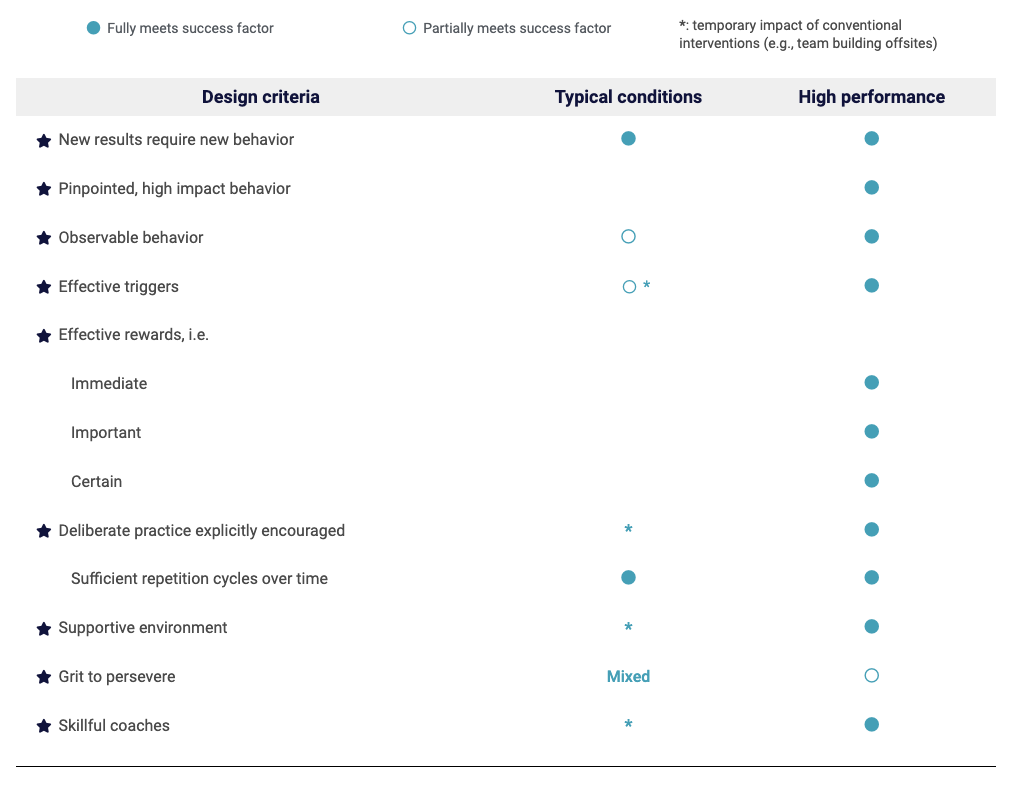
Taken together, these bodies of work suggest a set of criteria for understanding what’s missing in typical conditions—the conditions in which undesired or sub-optimal behavior persists—as well as how circumstances can be designed for faster, greater impact.
The table summarizes the extent to which these criteria are met in the typical conditions that top teams collectively work and perform in—and compares these typical conditions to high performance ones.
Typical Conditions — The Untapped Opportunity
Most senior teams want to accelerate desired behavior. It practically goes without saying. After all, new results of collective performance require new behaviors. What top teams may not realize is that, right now, they have the opportunity to supercharge behavior change. Most top teams regularly meet throughout the year—the question is, are they using this time as an opportunity to intentionally and systematically elevate performance.
That said, most of the remaining criteria for high performance are not well met. Though organizational values and even team agreements exist, they typically are not pinpointed, do not encompass the highest impact team behaviors, and are not prioritized for the immediate horizon. Absent these things, the most powerful antecedents at play are usually historical patterns, urgencies of the day, and individual agendas, all of which trigger current habits rather than new, preferred behavior.
Moreover, when team excellence isn’t assessed thoughtfully and objectively, the prevailing assumption is that “we’re pretty good” (despite frequent personal frustrations with team dynamics), and that good is good enough. There is no motivation for individual team members to improve their contribution, even if they want to. The balance of rewards and consequences leans in favor of going with the flow, rather than risk rocking the boat.
Occasional group interventions, such as “team building” offsites, can temporarily help. They might bolster existing triggers, like refreshing team agreements, identifying an improvement priority, prompting deliberate practice, or providing skillful feedback. However, interventions like these are usually short, take place in artificial settings rather than “on the field of play,” and have little influence on the ongoing balance of rewards and consequences. The outcome isn’t surprising: results that are short lived and have limited impact. Similarly, executive coaches for individuals rarely observe senior members’ performance, much less their performance within the senior team so, at best, they help to enhance individual—but not necessarily collective—performance.
High Performance Conditions — What’s Possible
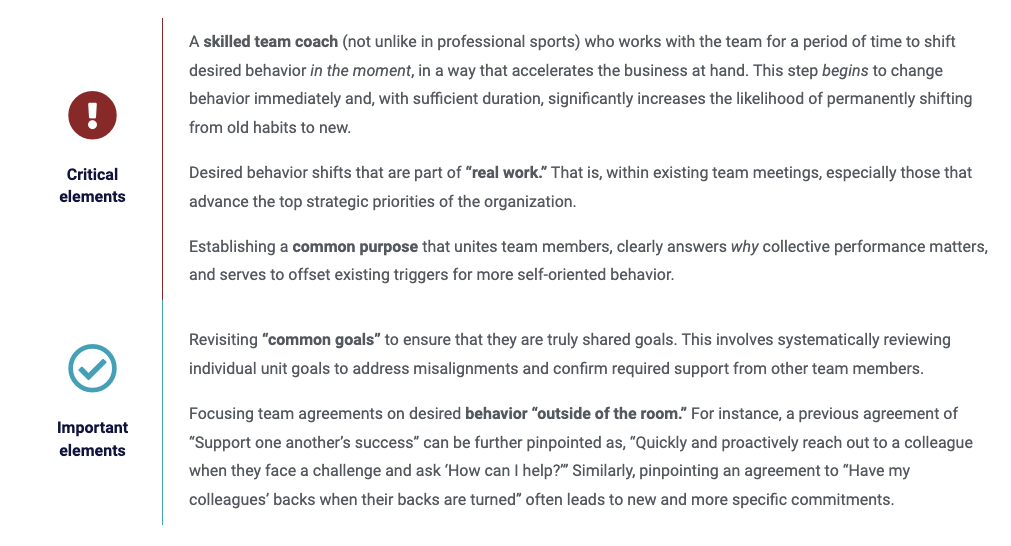
Typical conditions produce, well, typical results. High performance conditions—implemented with the help of a skilled coach—produce results that the top team may not have thought possible, at least not without significant, costly, risky investment.
When a coach works with the senior team as a team (not individuals) as they do real work, in real time, in the context of a strategic imperative—that’s when high performance happens. And contrary to what some might think, elevating performance doesn’t have to be a risky endeavor. Rather, it can be done in a light, targeted, agile and most importantly, effective way.
Guided by behavior science and mastery principles, the coach and team elevate collective performance. The work includes:
In addition to feedback provided by the coach, it’s key to strengthen rewards and consequences in meaningful, creative ways. Examples range from simple, appreciative acknowledgements of one another to recording and breaking down “gameplay” footage of a meeting to accelerate mastery of targeted shifts.
Finally, high performing top teams maintain consistent focus and tenacity until targeted shifts become habitual, business as usual. This discipline includes the practicality and resilience to treat slippage as expected on occasion in the short run, and unacceptable in the long run.
In summary
As Aristotle once observed, “We are what we do. Excellence then, is not an act. It is a habit.” For senior teams, “what we do” influences much about the health and performance of the organization. And perhaps surprisingly, behavior science and mastery principles can be readily, practically applied to shift meaningful habits in real time.
Changing high impact behavior in the workplace is neither instant nor easy. But, substantial gains in reliably shifting behavior and achieving new, related outcomes is clearly possible under a number of performance conditions in the workplace. It is an opportunity on the doorstep.