


Over 75% of people believe that happiness comes from finding an activity or job about which they are immediately passionate, but only 20% say they are truly passionate about their work.
Purpose-driven organizations are increasingly searching for reliable approaches to connect personal purpose to organizational purpose. It’s perhaps natural to assume that performance – and fulfillment – increase when this connection is made. And that’s indeed what our experience and emerging evidence indicates.
It’s also commonplace to assume that once this connection and related performance gains are realized, that there is no more to do here and that there is no more upside to consider. Maybe, but, before doing so, it’s worth considering Morten Hansen’s ground-breaking studies on drivers of individual high performance in the workplace.
Hansen, who is also Jim Collins’ co-author of “Great By Choice,” studied 5,000 managers and employees over a five year period to determine why some people perform better at work than others. He looked at a number of possible reasons, including passion and purpose. Hansen believes passion and purpose are two separate things and thus two separate possible performance drivers. Specifically, he defined passion as “doing what we love” and purpose as “doing what we contribute.” In his (and others) view, purpose asks, “What can I give the world?” Passion asks, “What can the world give me?”
Performance edge
Interestingly, Hansen found that “People who match purpose with passion perform much better, on average, than those who lack either purpose or passion or both.” His findings are noteworthy for a number of reasons.
First, this evidence suggests that purpose and passion are indeed separate things. Second, it is possible to combine these things in the workplace. Third, and most importantly, it is this combination – putting purpose and passion together – that differentiates top performers. In fact, this combination of the two was the second most important predictor of top workplace performance of all the possible factors that he investigated.
Finally, this difference was not primarily due to working endless hours. While those who combined purpose with passion did indeed work more hours (on average 50 hours per week instead of the 43 hours worked by others), this difference contributed very little to the difference in performance. Instead, Hansen’s research demonstrated that it was the greater intensity of their work habits, not the number of work hours, that made the difference in performance. Those who combined purpose with passion put more effort into the hours they worked.
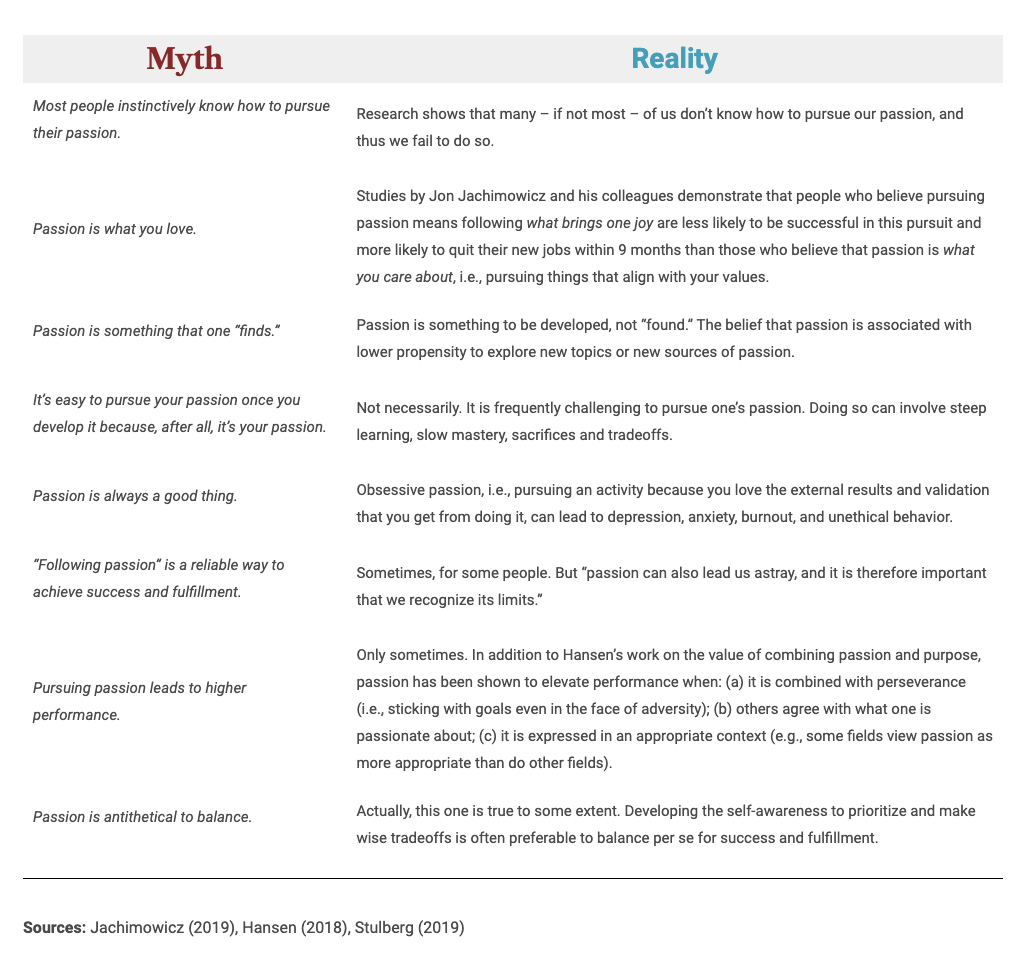
Facts from fiction
Given the apparent value of combining passion with purpose, it is important to be sure that we have a solid understanding of what passion is and isn’t in the workplace context that we are discussing.
Integrating purpose and passion
Combining purpose and passion in the workplace first requires that employees take responsibility as individuals to do so. Examples suggested by others for elevating the passion dimension include:
- Shaping roles to spend more time exploring the tasks that you are passionate about, or areas that may be of interest
- Working with inspiring people
- Getting to know coworkers, what they are passionate about, and how they view work (which in time leads to helping one another pursue passions)
- Or, clearly acknowledging when your job does not allow you to pursue your passions and deliberately develop strategies to pursue them outside of work
It is also important to understand that there are usually practical limitations within the workplace that are beyond our control, especially when going it alone. That’s why leaders can make a meaningful and sometimes lasting difference in the work lives of our people when we routinely engage in coaching discussions and provide active support for exploring ways to enhance purpose and passion. And, when senior leaders provide explicit endorsement and support (including role modeling themselves), the combined impact of combining purpose and passion may very well yield surprising benefits.