


Trust amongst members is an essential ingredient in most any high performance team, especially those that sustain excellence, and senior teams in organizations are no exception.
Though the importance of trust amongst team members is common knowledge, development of strong trust within top teams isn’t necessarily commonplace. Countervailing factors include metrics, goals and rewards that emphasize individual over collective performance, structures and roles that place team members at odds, limited time and opportunity to strengthen trust, and history and politics that encourage perpetual wariness.
This lack of trust within senior teams is certainly not for lack of expert advice. Articles and books on building team trust in the workplace are plentiful, and our purpose here is not to increase this volume. Instead, our intent is to give voice to a different perspective – that of top team members themselves. In our work with senior teams that are deliberately working to enhance team effectiveness by strengthening trust, we’ve observed similarities in the types of agreements, as well as the focus of specific solutions, that they identify.
As we turn to the voice of senior teams, let’s momentarily touch upon a well-known and very useful framework in the literature: the trust equation. Developed by David Maister and his colleagues, the trust equation suggests that trust within teams requires a combination of team members’ confidence in one anothers abilities (credibility), their reliability in follow through, their understanding and caring for one another (intimacy). Further the impact of these three factors is either strengthened or diminished by the degree of members’ other-orientation versus self-orientation.
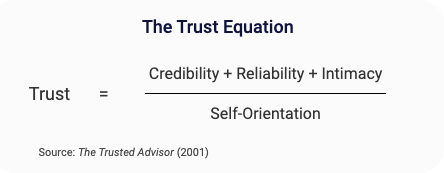
Taken together, these four factors seem to have validity and to be sound enough to support interventions. But, do they reflect the things that executives prioritize for themselves? The answer is “yes,” but there is a bit more to the story.
What executives want
The first place that most senior teams turn to as they develop their trust-building agreements is their Code of Conduct. Most companies have them, most teams quickly determine that they have room for improvement in modeling company values, and that this alone would help to build trust. That said, they also conclude that they need to go further.
Team members often cite attributes like the following as personally most important:
- My colleagues are as interested in my success and well-being as their own
- I know where I stand; my colleagues say to my face what they say to others
- I have confidence in my colleagues’ technical competence
- My colleagues do what they say they will do
- I feel safe in allowing myself to be vulnerable
In effect, teams frequently focus at this point in the dialogue on each of the four components of the trust equation, but to different degrees. Credibility, reliability, and other-orientation vs. self-orientation are definitely mentioned. But the feeling of being safe to take risks (a facet of the “intimacy” dimension) is particularly prevalent. This is consistent with prominent studies such as Google’s Project Aristotle that suggest that psychological safety is pivotal in team effectiveness*. As a term, “psychological safety” may not be something that most senior leaders identify with as a personal priority, but its essence is certainly recurrent in what senior teams emphasize in their trust-building agreements.
Another facet of the intimacy dimension, seeing and caring about one another as people, does not typically surface at this stage of deliberation. Does this indicate that senior teams neither need nor want to better understand one another as people? After all, even if this is suggested to senior teams for their consideration early in their discussions, the response is usually silence or outright dismissal.
Practices that matter
Once teams discuss, however, the specific things that they need to begin doing to really make a meaningful difference in their trust in one another, their conversation takes a turn. They begin by focusing on things that will help one another, such as proactive communication to peers. But, as they continue to test their agreements against their desired state description, the progression follows a familiar pattern.
- Share information about what’s going on in our areas with one another
- Address points of divergence, rather than let them linger
- Support/defend/”promote” one another to our own direct reports
- Ask one another’s advice and counsel
- Spend more social time together (get to know one another better)
Increasingly, team members sense that more direct and frequent interaction is required, especially to achieve their desire to feel safe. To everyone’s surprise, they progress to things that they would previously have deemed unnecessary and perhaps frivolous.
The core of conversations that build trust
In summary, whereas senior teams do not place much emphasis on strengthening interpersonal understanding and relationships at the outset of trust-building discussions, and would certainly dismiss earlier suggestions that they spend precious time “getting to know one another better,” that’s precisely what they suggest on their own once they have thought more deeply about the problem, the causes, and possible solutions for building the conditions that are most important to them.
*It should also be noted that not all studies find a strong relationship between psychological safety and group effectiveness. For instance, Wooley, et al.’s work on collective intelligence has not found a significant relationship between the two.