



So what does it take to lead a continuously improving organization?
There is no single way to lead that is “it.” There are many effective styles, and we each have our own unique blend that we apply differently, depending on the circumstances.
But as change has become the only constant, the norm rather than exception, one begins to wonder: are there competencies that give leaders an edge? That promote the resilience and emotional capacity leaders need to continuously improve themselves and their organizations in order to maintain competitive advantage?
Research finds that there are. These mindsets and capabilities help leaders achieve their goals in work and life through a strong sense of purpose, belonging, lightness of being, resilience, and control.
Of course, honing leadership is a lifetime endeavour. That said, leaders can leverage certain high-yield areas to hasten progress and improve depth. This involves learning from others, reflecting on personal experiences, embracing transformation opportunities that test our limits and challenge our thinking, and, perhaps, some focused leadership development work.
Why leaders matter
Building leadership capability takes real time and effort. Of course, some are blessed with more natural talent than others. But we can all become better leaders, and each of us must individually decide on the value of the investment and make the corresponding commitment to growth.
And this investment is worthwhile. To see why, we can simply turn to those we admire. We have all been influenced by great leaders. They influence how we think and feel about ourselves, and have made invaluable impacts in shaping the world around us.
Nelson Mandela taught us about vision and purpose as he led his country out of apartheid. His commitment to equality and unity—despite incredible odds—ended decades of severe, institutionalized discrimination.
Marie Curie amazed us with dedication and passion, as her pioneering research on radioactivity made her the first woman to win a Nobel prize, and the first person in history to win two.
Steve Jobs showed us how to spur innovation. Starting in the ‘70s, he unleashed a wave of innovation that left an indelible mark on how we interact, entertain, and live.
Katherine Johnson changed the world with her mathematical genius and personal initiative, which led to the success of the first and subsequent U.S. crewed spaceflights.
Jack Ma impresses us with his ability to inspire incredible growth. The success of Alibaba comes not just from his brilliant foresight, but also his encouragement of employees to “think big” and “work for their dreams.”
To be sure, high profile leaders change the course of history. But we also know that leadership at all levels has the power to build morale, instill confidence, unite people, and inspire us to achieve.
In fact, it is often those we have interacted with personally that have the greatest effect. We all have stories of leaders who have touched our lives, maybe a school teacher who believed in us when we didn’t ourselves, or a manager who coached us through challenging times. And to some degree, most of us would like to have that impact on others. This is a key force that compels us to become better leaders.
Do organizations cultivate leaders?
Organizations are fully aware of the impact leaders have on performance. They see the value and make distinct investments in their people. Indeed, the vast majority of large organizations have their own, dedicated development programs. Across the world, executives flock to business schools for expensive leadership classes. And HR builds in sophisticated selection criteria and approaches to evaluate and filter applicants to senior positions on their demonstrated ability to lead.
So, given these enormous investments and the importance of leadership, how are companies doing at building strong pipelines in their organizations?
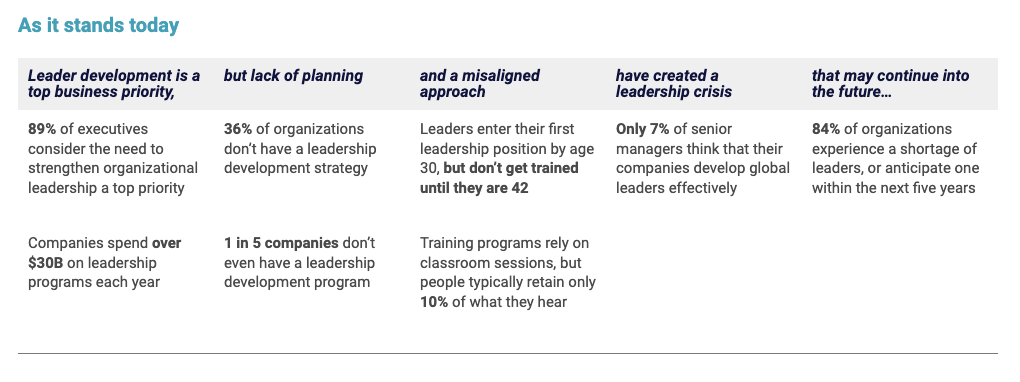
Clearly, there is significant room for improvement. We suspect there are at least two key reasons for this. One is that there isn’t a direct and immediate payoff, so year by year companies trim the edges of their investments in people development to meet budget reduction targets, often eroding their core value, creating a vicious cycle of less investment → poor outcomes → less investment.
It’s also true that leadership programs are just plain hard to do well, and when done poorly, they provide little benefit to their participants and their organizations. This may explain the downward spiral of poor outcomes leading to less investment.
The need for self-leadership
Notwithstanding the challenges, we need to find a way to address the leadership gap. We must enable leaders to be effective in driving performance, while sustaining passion for their work and satisfaction with their lives.
To answer these questions, we present a model for self-leadership, built upon leadership research and a framework developed by McKinsey in 2014. The goal is to help people lead with impact, build resilience, and achieve personal fulfillment.
Our model contains 7 elements, divided into 4 sections. Each is designed to work with the others to create a powerful synergy for personal effectiveness and happiness.
1. Improve intuition & habit
- Intuition & Habit — tune in to your patterns of thought, increase situational-awareness, harness the power of habit
2. Align purpose and career
- Purpose — tap into your core strengths, discover meaning and vision, lead with conviction, courage and confidence
- Position — determine your needs, wants, ambitions, opportunities, then chart a path to success
3. Engage others
- Connect — develop a meaningful and powerful network, build trust and strengthen your reputation, seek out sponsorship
- Relate — build thriving relationships with those you lead, cultivate authenticity, scale your vision by inspiring others
4. Energize and sustain yourself
- Reframe — reframe challenges as opportunities, adopt mindsets and beliefs to reveal possibility in the face of setbacks
- Balance — manage energy, work and live more fully, bounce back quicker, and sustain high performance over the long run

What each element offers
Each element is important. According to McKinsey research, mastery of one resulted in only 5% of respondents being satisfied with their leadership ability—when leaders mastered four, leadership satisfaction increased to 80%. In addition, by building on these practices, leaders are 4x more likely to feel equipped to navigate complex change, and 20x more likely to be satisfied in their personal and professional lives.

Bringing it all to life
In addition to knowing what has the greatest payoff for leadership development, it is also critical that we consider how the program is delivered. Experience shows that some key ingredients make a significant difference.
Foremost, the learning environment needs to be real. Artificial constructs like simulations and case competitions used to complement (virtual) classroom delivery don’t do the job. We recommend leadership development take place within the context of a live business project, preferably a strategic imperative. Such an endeavor poses demands and offers opportunities for definitive and immediate feedback to the leader, motivating and reinforcing growth.
To set the proper trajectory, we start with a thorough self and 360 assessment. From there, leaders commit to their personalized goals based on key insights on strengths, gaps, and blind spots. Their goals are developed in conjunction with a growth path, ideally spanning 9-12 months and detailing several milestones. The journey is further customized by selecting from a variety of features, including self-directed learning tools, peer storytelling events, coaching, and mentor check ins.
Finally, we accelerate applied learning with live-team coaching. Real-time feedback, while doing real work, has an extraordinary lift on performance improvement. The approach illuminates group dynamics that lie hidden beneath the surface, immediately enhances collaboration, and amplifies collective performance. And here there is a unique opportunity to employ a novel technology—live-team rewind & replay—which allows teams to analyze gameplay footage, gain new perspectives on entrenched patterns, and build new behaviors in the moment that really work.
Embracing development
Given these turbulent economic times—where businesses need to continually adapt and improve in order to survive—it is essential to efficiently and effectively bolster leadership capacity. The model we have outlined holds promise for senior and aspiring leaders alike.
The self-leadership development program offers a tremendous opportunity to dramatically upscale outcomes by addressing fundamental deficits found in current methods.
It delivers tangible value today by improving the execution of high priority projects. This not only amplifies learning, it also provides measurable and immediate ROI to the organization. This payback protects the program against budget cuts, and sets in motion a virtuous cycle of leadership development.
Finally, our program addresses the underpinning mindsets, behaviors, and patterns that fuel the organizational agility needed to remain competitive and relevant. And as a result, it creates alignment between the organization, team performance, and individual growth.