


Leaders routinely set the direction of their companies, laying out strategic plans, and funding lists of initiatives with the intent of improving results. What ensues is a test of tenacity and resilience, to see through execution and realize target outcomes.
It is often expected that most ambitious strategies will fail to live up to their potential, as the statistics overwhelmingly support this hypothesis. This has fueled familiar statements like ‘culture eats strategy for lunch’.
In response, some executives lower their sights, simply expecting less from their organizations. Others are redesigning their operating model. Based on successes in technology development, these firms rushed to transpose an agile approach more broadly in their organizations. Some have struggled and stalled, while others are reaping the benefits of integrated networks of teams, pushing decision-making to the front lines, and leveraging greater autonomy to create value for customers.
While we are proponents of enterprise agility, we also know that it requires executives to reimagine their aspirations, for their organization and their leadership teams. The traditional ways are not holding up. Annual retreats producing multi-year plans with periodic accountability check points are giving way to a more dynamic interaction.
We have examined how leadership teams are evolving, and research shows that those adopting what we call an Aim Higher approach are clearly outperforming their peers. By harnessing the unused power of the team, they are able to take stronger, more unified positions while simultaneously remaining adaptable to the uncertainties they face.
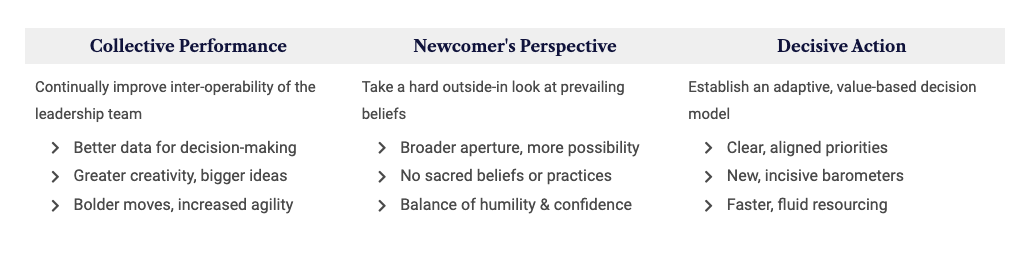
Here, we highlight three characteristics we found were common to exceptional leadership teams. These practices significantly explained the difference from status quo to topshelf performance: they continually improve the leadership teams’ collective performance; they frequently press pause and take a fresh, newcomer’s perspective; and, they take decisive action based on a robust approach to defining, setting, and rebalancing priorities.
Collective Performance
More than half of senior executives report that the top team is underperforming. Exceptional leadership teams, in contrast, openly and routinely evaluate how they are doing and take measured steps to progress. As a result, they avoid getting trapped in unproductive norms and patterns that lead to poor performance.
One key differentiator of these high performing teams is that they have better information for decision-making. They confidently share detailed data with one another on their units, without fear of politicking or power plays. They actively listen without undo judgement, and are able to tap into trusted networks, inside and out, to gain unfiltered feedback.
They produce bigger ideas by leveraging diverse opinions, encouraging creativity, and engaging in productive conflict. And they have a greater propensity to translate ideas into action. They more willingly make bold moves knowing they have each other’s back, leverage each other’s strengths to get things done, and flexibly flow resources within and across boundaries to where they will serve the greatest value.
By working better as a collective, and placing the value of the whole over the individual, effective leadership teams focus on what they are uniquely positioned to do. They delegate operational authority and responsibility to those closest to the customer, retain accountability and oversight, and focus on steering the organization to outsized performance.
Newcomer’s Perspective
Improving collective performance frees up time. Time that exceptional teams use to step back and take a newcomer’s perspective. This clear-eyed, outside-in viewpoint enables them to avoid common biases and pitfalls.
Many teams suffer selective perception, the tendency to see a particular situation or issue (consciously or unconsciously) from a myopic, self-serving perspective. This is compounded by confirmation bias, filtering data in favour of a predisposition. We are all subject to these biases, but exceptional teams invoke protocols to effectively challenge prevailing positions and broaden horizons.
Another critical success factor for leadership teams is knowing how to separate signals from noise—when to be tenacious in rough seas and when to make substantive course changes to avoid missteps or worse. Without this sensibility, firms can suffer escalation of commitment, a tendency to follow a less productive course based on a fear that they will be judged to have made poor decisions and wasted resources. Effective teams don’t shy away from tough conversations, but do it in a way that is task- and-team oriented. They are able to recognize that fast failure is the travelling companion of extraordinary achievement, and swiftly take action when needed.
Successful leaders learn to trust their gut, making tough decisions when needed despite little information. Rising to the top of an organization implies sound instincts. But research shows this holds true only when previous experience substantively applies to the situation at hand. As markets become increasingly turbulent, circumstances become far less familiar, and the cost of misplaced confidence can be high. Exceptional teams balance confidence with humility, skillfully keeping egos in check without undermining passion and conviction.
Decisive Action and Reaction
Making good, fast decisions is challenging at the best of times. And analysis shows that most companies fall into one of two categories: fast, command and control decision-making centered on a few people at the top, or slow, methodical decision-making taking a more broad-based, inclusive approach. The former generally suffer from resistance to change and misinterpretation along the chain of command, and the latter from sluggish response times and missed opportunity.
The middle road, a compromise between these two states, isn’t the answer. When it comes to engaging the workforce, reducing innovation cycles, and improving customer responsiveness, decision speed and quality are needed to get an edge. To achieve this, exceptional teams install a systematic approach to improve information flow and resource allocation.
Like their counterparts, these leaders make use of a broad-based dashboard to manage their businesses. But they also establish a parsimonious set of indicators that focus on the value drivers of their current strategic imperatives. The metrics employed are pruned and reset continuously to ensure full visibility on what matters most.
This new, incisive set of measures prompts timely debate and informs choices. Since these teams also take collective ownership over performance, they are able to swiftly calibrate priorities and reallocate resources to where they will have the greatest impact.
High Aim, Less Risk
A commonly held belief is that more ambitious goals come with greater risk. This mindset assumes that the management practices in use are operating at the frontier of effectiveness and efficiency. It turns out that this is not the case. Maladaptive leadership behaviors are commonplace, loud voices accrue disproportionate resources, distorted information flow slows responsiveness, and power struggles take precedence over enterprise value creation. The upside: small investments in how the leadership team operates can enable leaders to Aim Higher and improve execution results.
Leadership teams that build collective performance, routinely take a newcomer’s perspective, and establish an adaptive, value-based decision model for decision making will progressively improve behaviors, make better use of resources, and increase decision speed and quality.
The net effect is that they are better able to see opportunity in uncertainty, set more ambitious goals, and harness the power of their agile organization to execute with speed and deftly maneuver when confronted with unforeseen events.